• Login
  • Subscribe Now For Picks
TeamRankings
Follow @teamrankings
  • Home
  • NBA Playoffs 2013
  • NBA
    • Home
    • NBA Forum
    • Game Predictions
    • Season Projections
    • Game Winner Picks
    • Point Spread Picks
    • Over/Under Picks
    • Prediction Accuracy
    • Rankings
    • Stats
    • Scores
    • Odds
    • Trends
    • Standings
    • Schedules
  • MLB
    • Home
    • MLB Forum
    • Game Predictions
    • Season Projections
    • Game Winner Picks
    • Money Line Picks
    • Over/Under Picks
    • Prediction Accuracy
    • Rankings
    • Stats
    • Scores
    • Odds
    • Trends
    • Standings
    • Schedules
  • NFL
    • Home
    • NFL Forum
    • Game Predictions
    • Season Projections
    • Game Winner Picks
    • Point Spread Picks
    • Over/Under Picks
    • Office Pool Picks
    • Prediction Accuracy
    • Rankings
    • Stats
    • Scores
    • Odds
    • Trends
    • Standings
    • Schedules
  • NCAAF
    • Home
    • NCAAF Forum
    • Game Predictions
    • Season Projections
    • Game Winner Picks
    • Point Spread Picks
    • Over/Under Picks
    • Office Pool Picks
    • Prediction Accuracy
    • Rankings
    • Stats
    • Scores
    • Odds
    • Trends
    • Standings
    • Schedules
  • NCAAB
    • Expert Bracket Picks 2013
    • NCAA Tournament 2013
    • Betting Picks Grid
    • Game Winner Picks
    • Point Spread Picks
    • Over Under Picks
    • Prediction Accuracy
    • Conference Tournaments
    • Bracketology 2013
    • Season Projections
    • News & Analysis
    • Odds & Lines
    • Rankings
    • RPI Rankings
    • Strength Of Schedule
    • Stats
    • Trends
    • Teams
    • Players
    • Scores
    • Schedules
    • NCAAB Home
  • Blog
  • More Info
    • About Us
    • Help
    • Meet The Nerds
    • FAQ

The Importance Of Seeding (Part 1): Three Factors That Make Seeding More Important Than You Realize

  • 5 comments - NCAA Basketball, NCAA Tournament - posted by Monte McNair on February 21, 2012

[This article is a part 1 of a 2-part guest post conceived of and written by Monte McNair. Part 2 can be found here. Monte analyzes both college basketball and college football at his blog Outside The Hashes, can be found on Twitter at @OTH_blog, and was a member of the 2012 Stat Geek Mock NCAA Tournament Selection Committee.]

With a month left in the season, most of college basketball is focused on who’s in and out of the tournament. Those teams near the cut line are on the Bubble, while teams that are securely in the tournament are Locks with little worry of falling out of the bracket and seemingly little left to gain with their dance cards punched.

Turns out, there’s still plenty to play for, especially at the top. As every fan knows, the NCAA Tournament is seeded from 1 to 16 in four separate regions. The top seeds are rewarded by being placed at locations close to home, protected from a home-crowd disadvantage, and–most importantly–pitted against easier opponents.

That last point is even more pronounced than one might expect. Obviously every team wants to move up a seed line, but the importance of climbing each rung of the seeding ladder might surprise.

Factor #1: Uneven Distribution of Team Strength

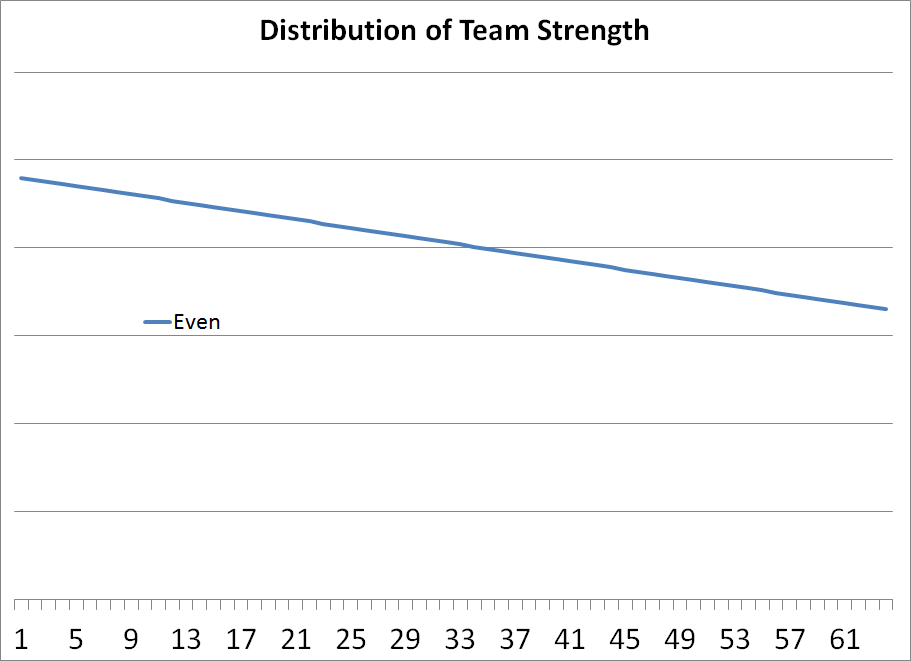
Let’s assume that the quality of teams is evenly distributed such that the difference between the best team and the 2nd-best team is the same as the difference between 2nd and 3rd and between 9th and 10th and between 63rd and 64th, and so on. If we graphed that, we’d get a straight line, sloping downwards, like this:
However, the teams aren’t quite distributed evenly. The best teams are a clear cut above the rest. Let’s look at how the best 64 teams are actually distributed:
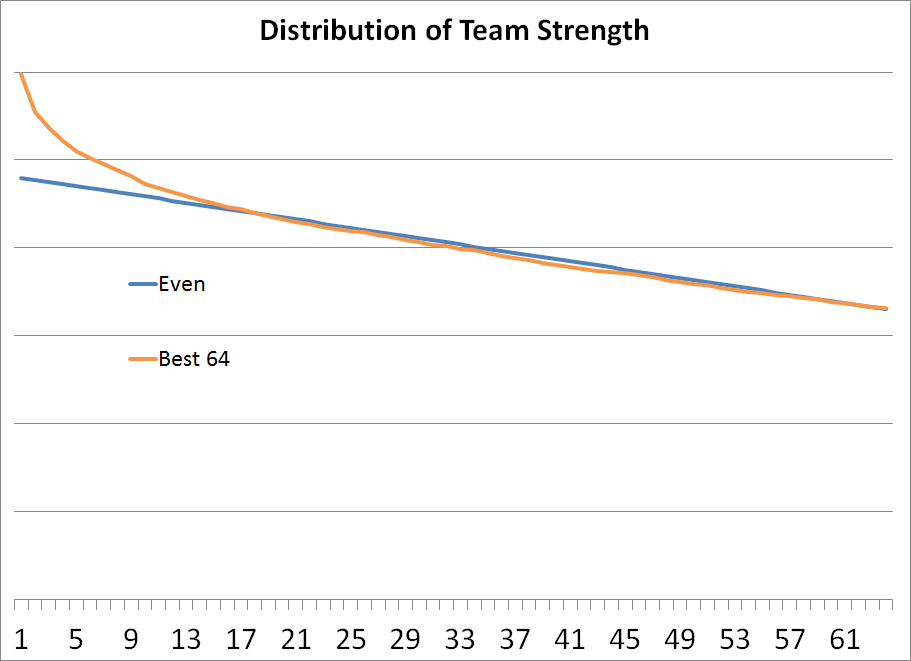
The top teams increasingly put more room between them and the team below them, before it flattens out around the 15th-best team.

What this means is that avoiding the top teams is imperative. In an even distribution, playing the #1 and #50 teams would be about the same as playing the #25 and #26 teams. However, in reality, playing the #1 and #50 teams is much more difficult due to the quality of the best teams.

Factor #2: Automatic Bids Dilute The Field

We’re not done yet, there’s one more wrinkle and that is the NCAA policy of granting an automatic bid to each conference champion. The tournament therefore ends up with not the 64 best teams but with the best 45-50 teams and then a group of weaker conference winners.
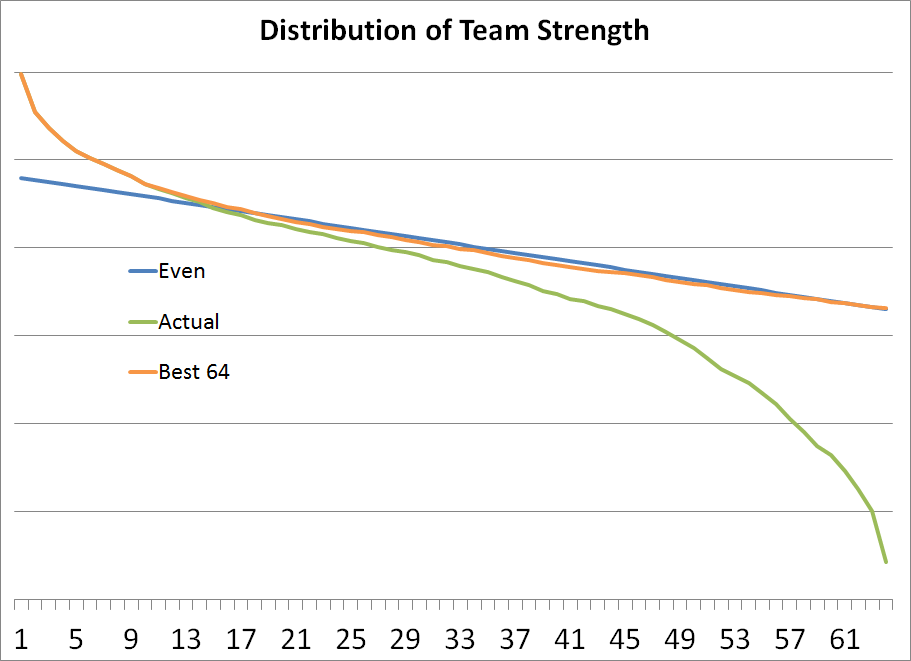
There are actually two things going on with the green line, which graphs the actual 64 tournament teams. First, in the middle of the graph, there is a slight separation due to some of the at-large bids not going to the actual strongest teams (due to teams underachieving, or whatever the case may be).

Second is the more important piece: the tail at the end of the graph is the one-bid conference automatic winners. These are the teams that occupy the 13th through 16th seed lines.

I think you can see where this is going: grabbing one of those top seeds really helps a team by giving them a 1st-round game against a much weaker opponent.

Factor #3: The Selection Committee Makes Mistakes

So we’ve identified two big reasons why seeding is not uniform: drawing the weaker automatic bids and avoiding the best teams are of increased importance. Before, we go any further, let’s look at how strong the teams at each seed line actually are.

For the same reasons that we saw the slight drop off in the green line above, teams won’t be seeded exactly according to their true strength. This will push teams somewhat towards the middle.
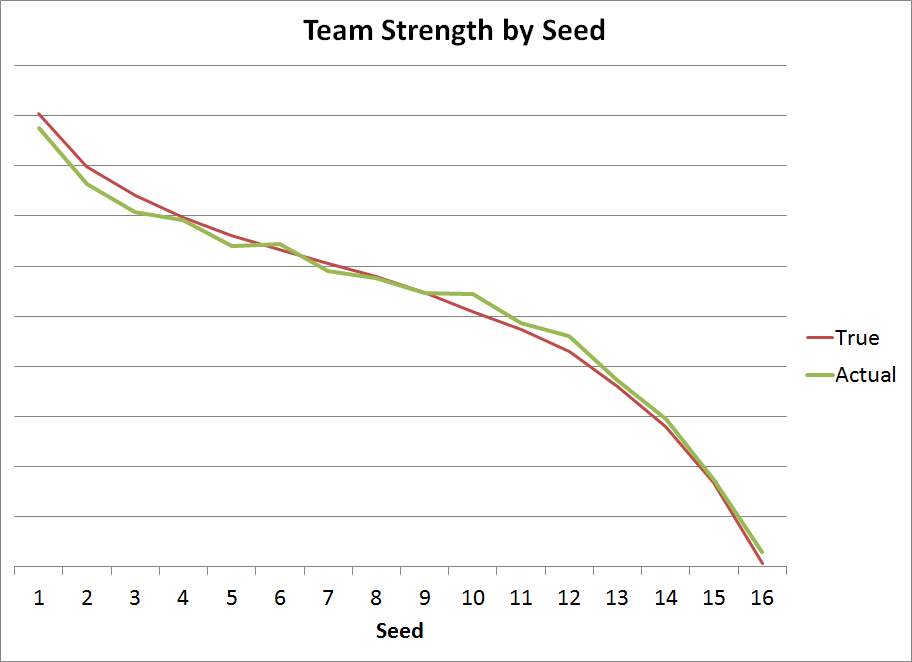
The red line is team strength if the seeding were “true”, meaning the 4 best teams were seeded #1, the next 4 #2, and so on. The green line, showing the average team strength by a team’s actual seed, shows a slight push towards the middle with the top seeds being a little worse than expected and the bottom seeds slightly better.

It turns out this effect is minimal, meaning teams are generally seeded pretty close to their true strength. The selection committee does a pretty decent job at seeding — at least when you average things out over the long haul. Any given team could still be much higher or lower than deserved.

Putting It All Together: Path Difficulty

What does this all mean about a team’s chances of advancing based purely on their seed?

To determine that, I calculated a Path Difficulty for each team by looking at their potential opponents in each round, weighting by the likelihood of each opponent making it to that round (for instance, if you’re an 8-seed across from #1 seed Kentucky and #16 seed Texas Southern, both of them are potential 2nd-round opponents, but clearly Kentucky is much more likely to be your opponent), and then calculating the probability of an average tournament team winning that game.

The easiest way to think about Path Difficulty through a certain round is that it is the chance of an average tournament team advancing past that round given that team’s path. Let’s start with the first round. This is pretty easy, as the only factor is your opponent. As we expect, the chart matches the previous graph of team strength by seed.
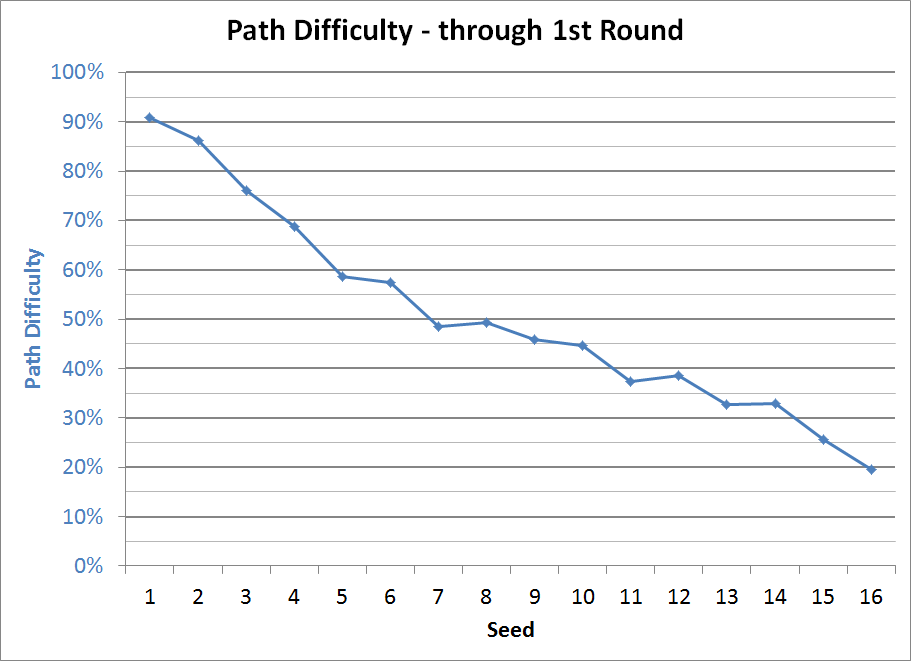
What do the second and later rounds look like? They’re a bit more complicated, since teams are no longer matched up against a single opponent.

Come back tomorrow to see how skewed the curves get, especially for the #8 and #9 seeds.

  • Dan

    In your Path Difficulty graph, how can a #1 seed have > 90% Path Difficulty (or rather, the axis should be labeled Chance of Advancing) but its opponent, the #16 seed, has almost 20%?  The sums don’t make sense for this first round, where 1 always faces 16, and there’s no weighting by previous rounds.  And it’s not just the First Four throwing it off; the #15 seeds are around 26% but the #2 seeds are about 87%.  Can you explain how this can be?

  • http://twitter.com/OTH_blog Monte McNair

    Dan, I am using a simple “baseline” team in order to strip out the effects of actual team strength and simply try to isolate the effects of seeding. This baseline team I usually call an “average tournament team” and ends up being something like a 10-seed. That’s why the numbers are not symmetrical (they would be if I used actual team strength). I would concern yourself less with the actual values and more with the relative values, or in other words, the shape of the graph.

    My nomenclature might have been a poor choice. Perhaps I should call this “Path Ease” or, if I leave it as Path Difficulty, flip the graphs.

  • SportsByTheNumbers

    Since top seed have always won their first-round matchups against 16 seeds, why isn’t the Path Difficulty value for top seeds equal to 100%?

  • SV

    This is great…really looking forward to tomorrow.

  • http://twitter.com/OTH_blog Monte McNair

    Remember, this is just what an average tournament team would do. While a #1 seed has never lost to a #16, part of that is due to 16-seeds being extremely poor quality, but also due to 1-seeds being great teams. I’m trying to separate the two. So while a real #1 may be near 100%, even an average tournament team would be over 90% likely to advance past the first round given a #1 seed. That’s quite an advantage.

    Think about it like this: what if we took West Virginia or Purdue or some team like that and dropped them in as a 1-seed into an otherwise-normal bracket? What about as a 2-seed? A 3-seed? and so on. So we’re keeping the team we are focusing on constant, and the only thing that is changing is the path that they get through the tournament, i.e. the opponents they might face based on their seed.

Like this blog? Subscribe!

Get new posts delivered automatically to your email address!

Or Follow Via: RSS Twitter

About Us

  • Meet the Nerds
  • Contact Us

Categories

  • > Press
  • > Site Help
  • > Site Updates
  • > Stat Geek Idol
  • College Football
  • College Football Bowls
  • College Football Pick'ems
  • MLB
  • NBA
  • NCAA Basketball
  • NCAA Tournament
  • NFL
  • NFL Pick'ems
  • NFL Survivor Pools
  • NHL
  • Soccer
  • Tennis
  • Women's Basketball
  • NBA Basketball
  • NBA Basketball
  • Playoffs
  • Game Predictions
  • Betting Picks
  • Odds
  • Rankings
  • Stats
  • Schedules
  • Teams
  • NCAA College Basketball
  • NCAA College Basketball
  • NCAA Tournament
  • Conference Brackets
  • Game Predictions
  • Betting Picks
  • Odds
  • Rankings
  • Stats
  • Schedules
  • Teams
  • 2013 NCAA Tournament
  • 2013 Bracket Picks
  • 2013 Bracket Odds
  • NCAA Upset Picks
  • Point Spread Picks
  • Over Under Picks
  • NCAA Tournament Matchups
  • Game Winner Picks
  • Team Prediction Grids
  • NCAA Player Projections
  • NCAA Blank Printable Brackets
  • March Madness Brackets
  • March Madness Predictions & Picks
  • 2013 NCAA Tournament Predictions & Picks
  • 2013 Conference Brackets
  • 2013 SEC Bracket
  • 2013 Big 12 Bracket
  • 2013 ACC Bracket
  • 2013 Big East Bracket
  • 2013 Pac 12 Bracket
  • 2013 Big 10 Bracket
  • All 2013 Conference Brackets
  • MLB Baseball
  • MLB Baseball
  • Game Predictions
  • Betting Picks
  • Odds
  • Rankings
  • Stats
  • Schedules
  • Teams
  • NCAA College Football
  • NCAA College Football
  • Predictions
  • ATS Picks
  • Office Pool Picks
  • Pick'em Predictor
  • Prediction Accuracy
  • Odds
  • Matchups
  • Rankings
  • Stats
  • Schedules
  • Scores
  • Teams
  • NFL Football
  • NFL Football
  • Predictions
  • ATS Picks
  • Office Pool Picks
  • Survivor Pool Picks
  • Pick'em Predictor
  • Prediction Accuracy
  • Odds
  • Matchups
  • Rankings
  • Stats
  • Schedules
  • Scores
  • Teams
  • 2012-2013 College Bowls
  • 2012-2013 College Bowls
  • Bowl Pick'em Picks
  • Bowl Betting Picks
  • Bowl Spread Picks
  • Bowl Winner Predictions
  • Bowl Upset Picks
  • Bowl Odds & Lines
  • 2012-13 Bowl Schedule
  • BCS Title Game
© 2005-2013 Team Rankings, LLC | All Rights Reserved | Terms of Service | Privacy Policy
TeamRankings.com is not affiliated with the National Collegiate Athletic Association (NCAA®) or March Madness Athletic Association, neither of which has supplied, reviewed, approved or endorsed the material on this site. TeamRankings.com is solely responsible for this site and the accuracy and completeness of the information herein. Trademarks used herein are property of their respective owners.