TeamRankings.com
Get Smart About Sports
January 25, 2012 - by David Hess
A few days ago, some foolish Twitterite decided to try to convince The Sporting News’s Mike DeCourcy that he should stop referring to rebounding margin and start using offensive rebounding percentage and defensive rebounding percentage instead.
Unfortunately, Mike is well-known as a proud stats Luddite, and pestering him with a logical argument about rebounding margin’s flaws is a fruitless exercise.
I learned this the hard way once when I tried to convince him that predictive power ratings which take into account margin of victory are actually quite useful. Now, when Mike gets in a stat spat, I generally just smile and move on.
This time, though, something Mike said struck a chord:
@tsnmike: @heymarnold If a team has a good rebound margin, it’s a good rebounding team. If that’s something that matters to you. Many win w/out it.
Could he be right?
I know there are flaws with rebounding margin — it doesn’t take into account opportunity differences, and it lumps together two distinctly different tasks in offensive and defensive rebounding. But might it be good enough as a directional signal? Are the distortions introduced by the flaws small enough that they don’t matter?
To answer those questions, I took a look at the data.
Rest easy, stat heads: it turns out that his claim isn’t true. There are plenty of teams from the last five years whose rebounding margin managed to vastly overrate their true rebounding prowess. The most egregious examples are below.
To get an idea of which teams have been the most overrated by rebounding margin, I compared a team’s rank in rebound margin to the better of their ranks in offensive rebounding percentage (OR%) and defensive rebounding percentage (DR%). I used the better rank because if they were excellent at one end of the court, their poor rebounding at the other end was likely due to a strategic choice.
Here are all the teams since the 2006-07 season that ranked at least 50 spots better in rebounding margin than in either OR% or DR%:
| Season | Team | Reb Marg | Rnk | OR% | Rnk | DR% | Rnk | OVERRATED | Miss FG Marg | Rnk |
|---|---|---|---|---|---|---|---|---|---|---|
| 2006-07 | Kentucky | 3.1 | 79 | 31.3% | 199 | 68.7% | 162 | 83 | 7.8 | 3 |
| 2006-07 | Belmont | 2.8 | 83 | 33.0% | 147 | 68.3% | 175 | 64 | 5.0 | 30 |
| 2007-08 | Utah St | 5.0 | 38 | 33.6% | 91 | 69.7% | 149 | 53 | 7.4 | 8 |
| 2007-08 | SE Louisiana | 4.3 | 46 | 32.6% | 131 | 70.9% | 103 | 57 | 6.0 | 16 |
| 2007-08 | Murray St | 3.0 | 81 | 32.1% | 154 | 70.1% | 131 | 50 | 3.7 | 48 |
| 2007-08 | Georgetown | 2.6 | 96 | 31.3% | 186 | 69.2% | 165 | 69 | 7.9 | 6 |
| 2007-08 | Kentucky | 1.9 | 117 | 30.9% | 196 | 69.1% | 172 | 55 | 6.6 | 11 |
| 2007-08 | N Carolina A&T | 1.3 | 134 | 31.0% | 194 | 68.3% | 207 | 60 | 4.0 | 44 |
| 2007-08 | Appalachian St | 1.1 | 141 | 29.8% | 235 | 68.3% | 206 | 65 | 7.5 | 7 |
| 2007-08 | USC | 0.1 | 184 | 28.3% | 264 | 66.6% | 268 | 80 | 9.0 | 3 |
| 2008-09 | Wake Forest | 6.4 | 18 | 34.6% | 70 | 71.4% | 78 | 52 | 8.0 | 4 |
| 2008-09 | Kentucky | 5.5 | 30 | 33.8% | 88 | 70.8% | 106 | 58 | 8.3 | 3 |
| 2008-09 | Chattanooga | 2.6 | 90 | 32.1% | 144 | 69.5% | 164 | 54 | 2.7 | 59 |
| 2009-10 | California | 4.3 | 47 | 32.9% | 124 | 70.7% | 115 | 68 | 1.4 | 121 |
| 2010-11 | Georgetown | 2.6 | 99 | 31.8% | 151 | 69.8% | 176 | 52 | 4.7 | 28 |
| 2010-11 | Idaho | 1.9 | 127 | 30.1% | 204 | 68.5% | 236 | 77 | 5.8 | 8 |
| 2010-11 | Illinois | 1.7 | 133 | 30.3% | 198 | 69.4% | 196 | 63 | 4.4 | 34 |
| 2011-12 | New Mexico | 7.0 | 27 | 34.0% | 102 | 72.6% | 81 | 54 | 5.4 | 30 |
| 2011-12 | Cambell | 2.4 | 124 | 30.4% | 212 | 69.5% | 185 | 61 | 6.5 | 18 |
| 2011-12 | Mercer | 2.1 | 141 | 30.5% | 210 | 67.9% | 242 | 69 | 4.1 | 65 |
Notice some of these are very good teams, and Kentucky appears three times and Georgetown twice. So we’re not just talking about teams at the margins that nobody cares about.
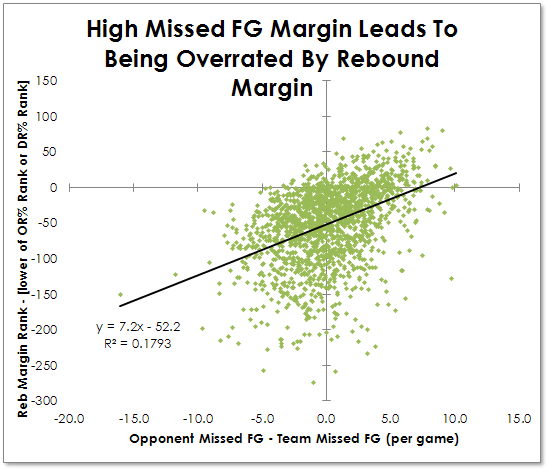
The last two columns above show a stat that partially explains why rebound margin overrates those teams. Missed FG margin is simply opponent field goals missed minus a team’s own field goals missed. Because defensive rebounds are easier to snag than offensive rebounds, teams that rank highly in missed field goal margin also tend to be overrated by rebounding margin.
More on that in a second, but first, there’s something else interesting about this group of teams.
There are quite a few NCAA tournament squads in the list above. When I reviewed their performance, I found something I didn’t expect — several were victims of upsets, and none of them pulled off any themselves:
– 2007 Kentucky (#8) lost to Kansas (#1) in 2nd round
– 2007 Belmont (#15) lost to Georgetown (#2) in 1st round
– 2008 Georgetown (#2) lost to Davidson (#10) in 2nd round (UPSET)
– 2008 Kentucky (#11) lost to Marquette (#6) in 1st round
– 2008 USC (#6) lost to Kansas State (#11) in 1st round (UPSET)
– 2009 Wake Forest (#4) lost to Cleveland State (#13) in 1st round (UPSET)
– 2009 Chattanooga (#16) lost to UConn (#1) in 1st round
– 2010 California (#8) lost to Duke (#1) in 2nd round
– 2011 Georgetown (#6) lost to VCU (#11) in 1st round (UPSET)
– 2011 Illinois (#9) lost to Kansas (#1) in 2nd round
That’s a 1-4 record for teams seeded #2 through #6. Pretty bad. Obviously, I don’t think five games is a significant trend, but it’s interesting to note.
OK, now, back to the issue at hand.
This trend was obvious when looking at the first table, and it makes perfect intuitive sense. It’s also not breaking news to those familiar with advanced stats, but it’s worth pointing out for anybody new to the concept.
Defensive rebounds are more common than offensive boards, by about a 2 to 1 margin. So teams that force their opponents to miss a lot of shots, and don’t miss that many themselves, will be overrated by rebounding margin.
Here’s a chart that demonstrates the point. It’s clear that the higher a team’s missed field goal margin, the higher their rebounding margin rank is, compared to their OR% and DR% ranks.
But perhaps an even bigger reason to use offensive rebounding percentage and defensive rebounding percentage is simply that the two measure entirely different things. Why lump them together (along with other confounding factors) into rebounding margin?
I’m certainly not the first person to bring this up. A famous (to stat geeks, at least) example is John Gasaway’s Rebound Margin Must Die.
But John’s post was distinctly lacking in charts, which are a staple of any geek’s reading diet. So, here is John’s argument, summed up in visual form:

Many teams grab a high rate of defensive rebounds, and a low rate of offensive rebounds, or vice versa.
This is clearly often a strategic choice; as teams put more or less emphasis on transition offense or defense, rebounding will suffer or improve as a result.
However, offensive and defensive rebounding do take slightly different skill sets, as well. Defensive rebounders generally start with a positional advantage when a shot is released, so defensive rebounding is more about blocking out, while offensive rebounding is more about maneuvering around an obstacle.
Think of the difference between an offensive linemen and a defensive linemen. While many of the physical gifts necessary to excel at the two tasks are the same, the specific skills and footwork involved are not.
The moral of the story here is that offensive and defensive rebounding percentage tell us more about a team’s actual rebounding skills than rebounding margin does.
Unfortunately, merely being better doesn’t cut it. Until these stats are widely accessible and easy to use, people will stick with what’s in front of their nose. As Mike put it:
@tsnmike: @heymarnold You know, I haven’t seen “rebound percentage” in a box score yet. Let me know when that shows up, and I’ll consider it.
So, write a letter to the editor! Call your Congressman! Tweet at every ESPN personality you can find online! Let’s get OR% and DR% wider acceptance, and take away one of the easiest excuses not to use them.
Printed from TeamRankings.com - © 2005-2024 Team Rankings, LLC. All Rights Reserved.